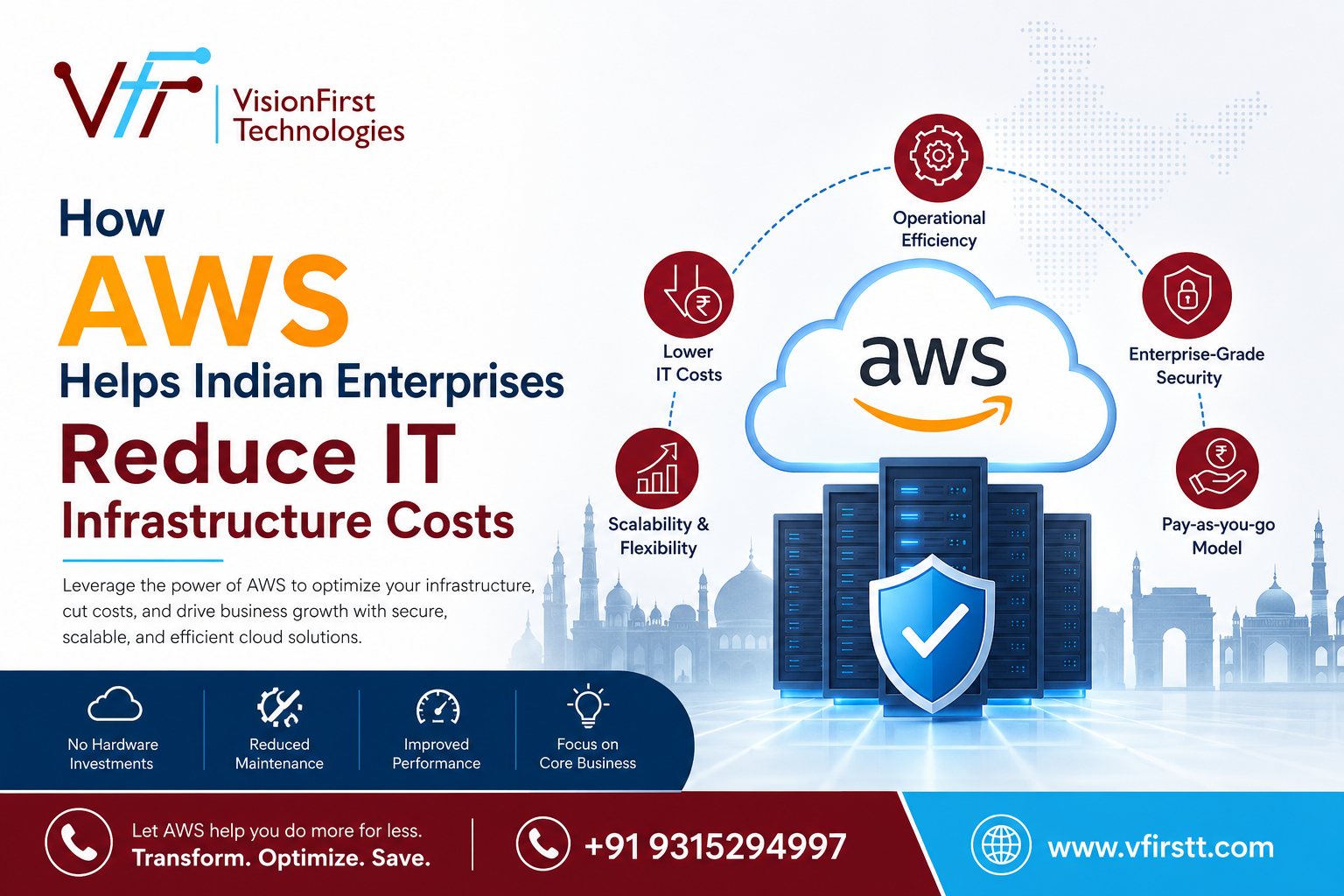
In today’s digital world, businesses are under constant pressure to improve performance while controlling expenses. Traditional IT infrastructure often requires significant investment in hardware, software, maintenance, security, and skilled resources. For many Indian enterprises, managing these costs can be challenging, especially when business needs change rapidly.
Amazon Web Services (AWS) has become one of the most trusted cloud platforms for organizations looking to reduce IT infrastructure costs while improving flexibility and scalability. AWS offers a wide range of cloud services that allow businesses to pay only for what they use, eliminating the need for large upfront investments.
This article explains how AWS helps Indian enterprises reduce IT infrastructure costs and achieve better business outcomes.
Understanding Traditional IT Infrastructure Costs
Before moving to the cloud, many businesses rely on on-premise infrastructure. This setup often includes:
- Physical servers
- Data centers
- Networking equipment
- Storage devices
- Software licenses
- Security systems
- Maintenance and support teams
These resources require substantial capital investment and ongoing operational expenses. Companies also need to plan for future growth, which often results in purchasing more infrastructure than they currently need.
As technology evolves, businesses must frequently upgrade hardware and software, adding even more costs.
What Makes AWS Different?
AWS follows a cloud-based model where businesses access computing resources over the internet. Instead of purchasing and maintaining physical infrastructure, organizations can use AWS services on demand.
Some key AWS advantages include:
- Pay-as-you-go pricing
- Flexible resource allocation
- High availability
- Enhanced security
- Global infrastructure
- Automatic scaling
This model allows businesses to focus on growth and innovation rather than managing expensive IT infrastructure.
1. Eliminates Large Upfront Investments
One of the biggest benefits of AWS is the elimination of large capital expenditures.
With traditional infrastructure, businesses must invest heavily in servers, storage systems, networking devices, and data center facilities before they can begin operations.
AWS removes this requirement by offering cloud resources on demand. Companies can start small and increase resources as their needs grow.
This approach helps Indian enterprises:
- Preserve cash flow
- Reduce financial risk
- Improve budget planning
- Avoid unnecessary hardware purchases
Instead of spending millions on infrastructure, businesses only pay for the resources they actually use.
2. Pay Only for What You Use
AWS operates on a pay-as-you-go model.
Traditional environments often result in underutilized servers because organizations purchase infrastructure based on future expectations rather than current requirements.
AWS allows businesses to:
- Scale resources up or down
- Pay for actual usage
- Stop paying when resources are no longer needed
This flexibility significantly reduces waste and improves cost efficiency.
For example, an e-commerce company may experience higher traffic during festive seasons. AWS allows additional resources to be activated during peak periods and reduced afterward, helping control costs.
3. Reduces Hardware Maintenance Expenses
Maintaining physical infrastructure requires ongoing effort and investment.
Organizations must regularly:
- Replace outdated hardware
- Perform maintenance
- Manage cooling systems
- Monitor power consumption
- Handle repairs
AWS manages the underlying infrastructure, reducing the need for businesses to maintain physical equipment.
As a result, enterprises save money on:
- Hardware upgrades
- Maintenance contracts
- Power consumption
- Data center management
This enables IT teams to focus on strategic business initiatives rather than infrastructure management.
4. Optimized Resource Utilization
Many businesses struggle with resource overprovisioning.
To avoid performance issues, organizations often purchase more infrastructure than necessary. However, much of this capacity remains unused.
AWS offers services that automatically adjust resources based on demand.
Benefits include:
- Better utilization of computing resources
- Reduced wastage
- Improved performance
- Lower operating costs
Auto Scaling services ensure businesses always have the right amount of resources without overspending.
5. Lower Storage Costs
Data storage requirements continue to grow for organizations across industries.
Traditional storage systems require:
- Expensive hardware
- Backup systems
- Maintenance
- Disaster recovery infrastructure
AWS provides scalable storage solutions that allow businesses to pay only for the storage they consume.
Organizations can choose different storage options based on their needs, helping optimize costs while maintaining performance and security.
This flexibility is especially valuable for enterprises managing large volumes of business data.
6. Reduced Disaster Recovery Costs
Building a disaster recovery environment using traditional infrastructure can be expensive.
Companies often need duplicate systems, backup servers, and additional data centers to ensure business continuity.
AWS offers cost-effective disaster recovery solutions that help businesses:
- Protect critical data
- Recover quickly from failures
- Minimize downtime
- Reduce infrastructure duplication
Organizations can create reliable backup strategies without investing in additional physical facilities.
7. Improved Operational Efficiency
AWS automates many routine IT tasks that traditionally require manual effort.
Automation helps reduce:
- Administrative workload
- Human errors
- Resource management complexity
- Operational costs
Services such as monitoring, deployment, backups, and security management can be automated through AWS tools.
This improves productivity while reducing the need for large infrastructure management teams.
8. Enhanced Security Without Extra Costs
Cybersecurity is a major concern for modern businesses.
Building and maintaining advanced security infrastructure on-premise can be costly.
AWS provides a wide range of built-in security features, including:
- Identity and access management
- Data encryption
- Threat detection
- Compliance monitoring
- Security logging
These capabilities help businesses strengthen their security posture while avoiding significant investments in additional security tools.
Strong security also helps reduce the financial impact of cyber threats and data breaches.
9. Faster Deployment and Innovation
Traditional infrastructure deployments can take weeks or even months.
Businesses often spend significant time:
- Procuring hardware
- Installing systems
- Configuring networks
- Testing environments
AWS enables organizations to deploy resources within minutes.
Faster deployment helps businesses:
- Launch products quickly
- Respond to market demands
- Improve customer experiences
- Accelerate innovation
The ability to move quickly can create significant cost savings and competitive advantages.
10. Supports Business Growth Without Infrastructure Risks
As organizations grow, their technology requirements increase.
Traditional infrastructure expansion often involves:
- New hardware purchases
- Data center upgrades
- Complex planning
- Long deployment cycles
AWS provides virtually unlimited scalability.
Businesses can expand operations without worrying about infrastructure limitations.
This scalability helps Indian enterprises:
- Support growth efficiently
- Reduce expansion costs
- Improve operational agility
- Enter new markets faster
Companies only pay for the resources they need at each stage of growth.
Industries in India Benefiting from AWS
Many industries across India are successfully reducing infrastructure costs through AWS adoption.
These include:
Banking and Financial Services
Financial institutions use AWS for secure data processing, analytics, and application hosting.
Healthcare
Healthcare organizations leverage AWS for secure patient data management and digital healthcare solutions.
Retail and E-commerce
Retail businesses use AWS to handle seasonal traffic spikes while controlling operational costs.
Manufacturing
Manufacturers utilize AWS for automation, analytics, and smart factory initiatives.
Education
Educational institutions benefit from scalable cloud infrastructure for online learning platforms.
Best Practices for Maximizing AWS Cost Savings
To achieve maximum savings, businesses should follow these practices:
- Monitor cloud usage regularly
- Use Auto Scaling features
- Optimize storage selection
- Remove unused resources
- Implement cost governance policies
- Utilize Reserved Instances where appropriate
- Conduct regular cloud audits
A well-planned AWS strategy helps organizations maximize value while minimizing expenses.
Why AWS Matters for Indian Enterprises
AWS has transformed the way Indian enterprises manage IT infrastructure. By eliminating large upfront investments, reducing maintenance costs, improving resource utilization, and providing flexible pricing models, AWS enables businesses to significantly lower their overall IT spending.
The cloud platform also supports innovation, security, scalability, and operational efficiency, making it an ideal choice for organizations looking to remain competitive in today’s digital economy.
For enterprises seeking to modernize their infrastructure and achieve long-term cost savings, AWS offers a practical and proven solution. With the right cloud strategy and expert guidance from Vision First, businesses can unlock the full potential of AWS while reducing operational costs and accelerating digital transformation.