

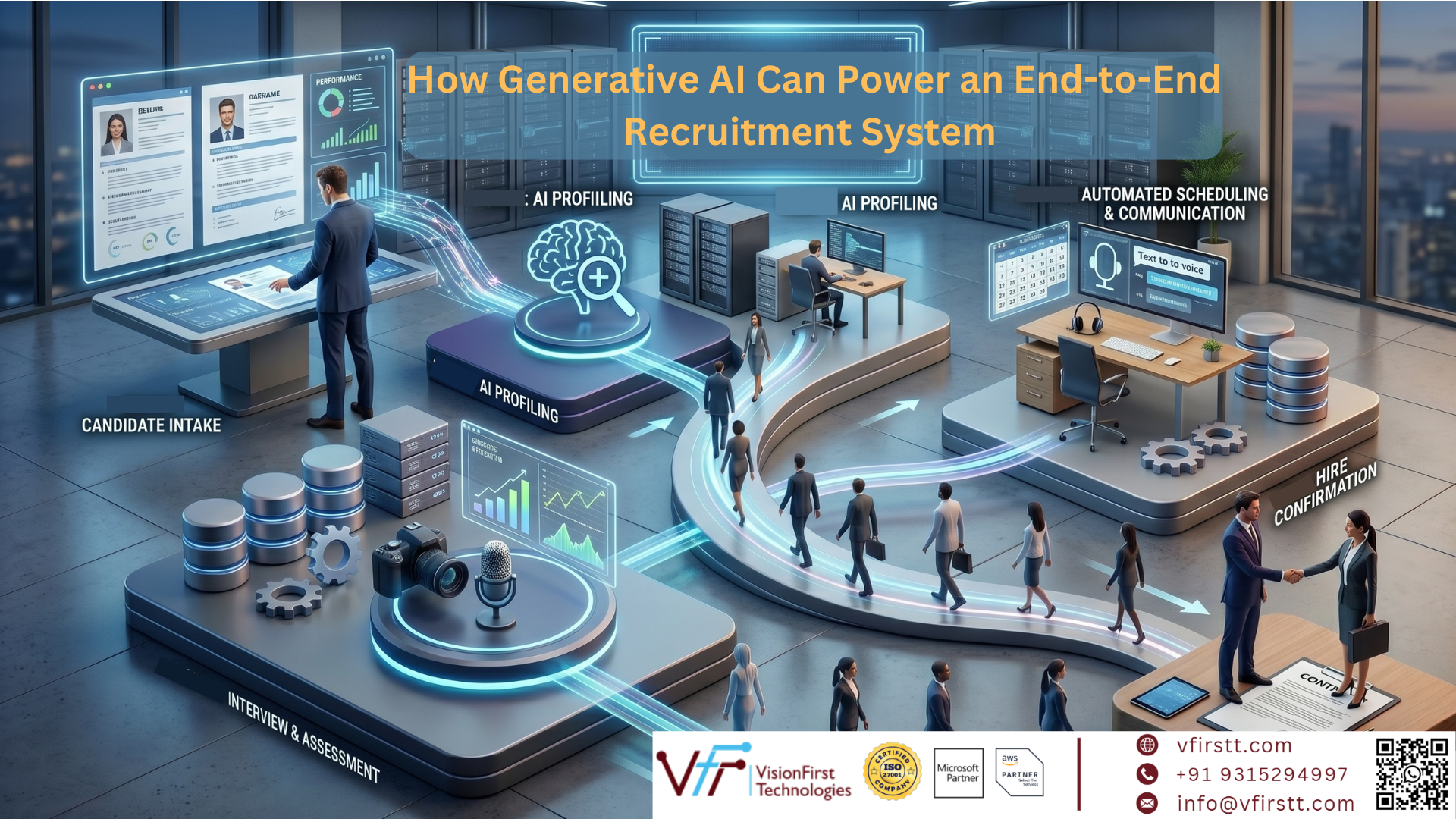
In earlier discussions about GenAI in HR, we explored how technologies like Generative AI are already supporting HR in areas. But AI is no longer limited to analytics dashboards or any other single purpose tool. Today, many organizations are adopting GenAI Solutions for Enterprise to move beyond isolated tools and build integrated systems.
Today, one of the HR functions where this shift is becoming particularly visible is recruitment.
Recruitment is traditionally one of the most operationally intensive processes in HR. From writing job descriptions to coordinating interviews, recruiters spend a large amount of time on repetitive hiring tasks.
Generative AI is changing this dynamic, especially through Generative AI Solutions Enterprise that combine automation, intelligence, and scalability.
A Multi-Agent Recruitment System
Instead of using separate tools for each task, organizations can design multi-agent systems, where AI agents collaborate across the hiring lifecycle. These systems are evolving into Multi-Modal AI Agent Systems, capable of handling text, voice, and data-driven workflows seamlessly.
This approach is to design a few powerful, composite agents, where each agent handles an entire stage of the recruitment process using a combination of:
- Generative AI [For reasoning and decision making]
- APIs (for external integrations)
- Data pipelines (for processing and storage)
These agents are connected through an orchestration layer, often powered by LLM Orchestration, where each stage updates a shared workflow state. Completion of one stage triggers the next, and HR interacts at key decision checkpoints.
This is where the concept of a multi-agent recruitment system becomes powerful — not as a theoretical idea, but as a practical, implementable architecture.
Let’s explore how this system works.
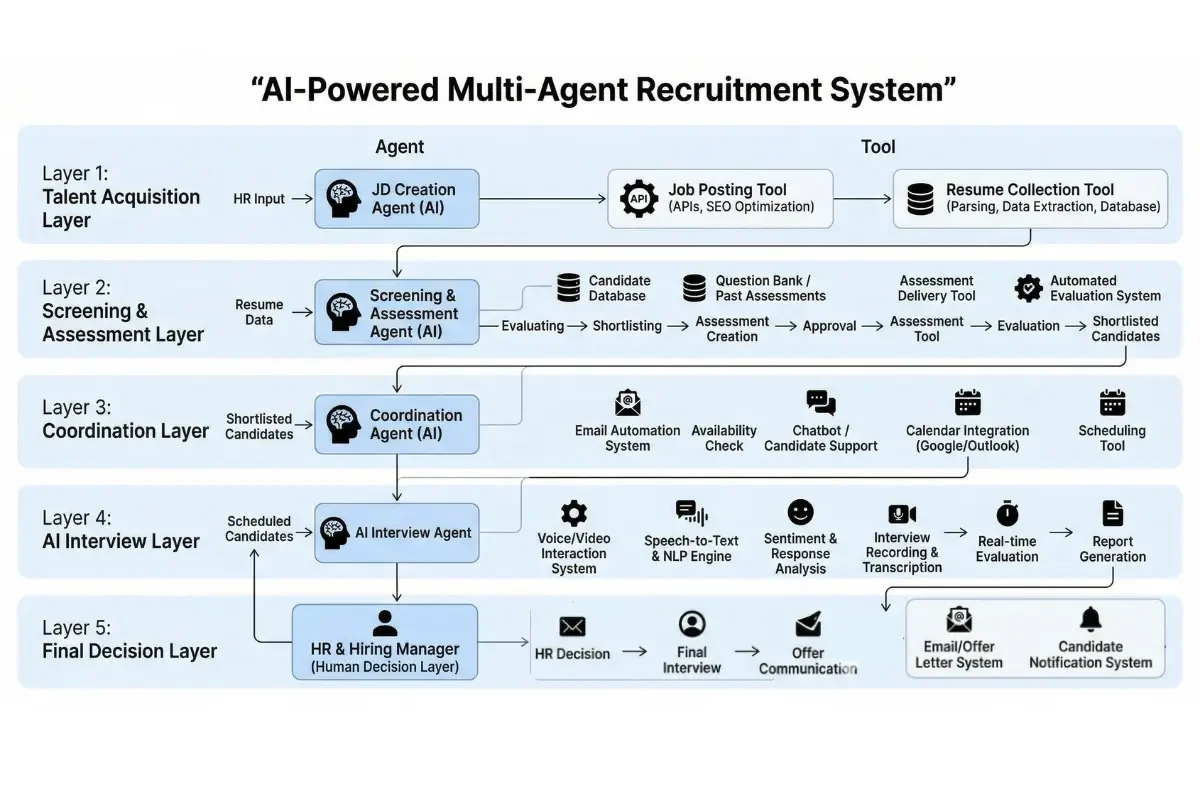
1. Talent Acquisition Layer
The process begins with the JD Creation Agent, which acts as the starting point of the recruitment workflow.
JD Creation Agent (AI Bot)
In a multi-agent system, this is where the first AI agent comes into play.
The agent generates multiple draft versions of the job description, allowing HR to:
- Review different variations
- Refine through a conversational interface (chat-based iteration powered by Real-Time Conversational AI)
- Align with company tone and compliance
Behind the scenes, this agent uses a combination of large language models, internal job description repositories, and prompt optimization techniques to generate structured and context-aware outputs.
Once the HR team finalizes and approves the JD, it moves forward automatically.
Job Posting Tool (Execution Layer)
Instead of the agent directly posting jobs, a Job Posting Tool handles execution through:
- API integrations with platforms like LinkedIn and job portals
- Content adaptation for platform-specific requirements
- SEO optimization for career pages and websites
Resume Collection Tool (Data Pipeline)
Once the job is published, the Resume Collection Tool begins with continuous data ingestion. It:
- Collects applications from multiple sources
- Extracts structured data (skills, experience, education, etc.)
- Stores candidate profiles in a centralized database
At this stage, the system builds a clean, structured candidate dataset, which becomes the foundation for the next step.
2. Screening & Assessment Layer
Once sufficient applications are collected, the next agent is triggered. This agent performs two major functions:
Intelligent Shortlisting
Instead of keyword matching, the agent uses semantic matching techniques:
- Converts job requirements and resumes into vector embeddings
- Measures similarity between candidate profiles and role expectations
- Ranks candidates using a multi-factor scoring model
This allows the system to identify relevant candidates even if the wording differs. For instance, a candidate with experience in specific tools may still match a broader skill requirement.
Assessment Creation & Distribution
The agent uses predefined question banks, refers to past assessments, and generates role-specific assessment questions using GenAI Solutions for Enterprise capabilities.
Before sending assessments, HR or Subject Matter Experts (SMEs) need to review the questions and modify or approve the assessment.
Assessment Delivery & Evaluation
Once approved, tools handle:
- Sending assessments to candidates
- Tracking completion
- Collecting responses
Evaluation can be done using automated scoring engines (MCQs, coding platforms) and rule-based scoring thresholds. Candidates are then shortlisted based on predefined score criteria.
3. Candidate Coordination Layer
After assessment-based shortlisting, the process moves into a stage that is often underestimated, but highly effort-intensive coordination. Instead of HR manually handling emails, follow-ups, and scheduling, a coordination agent takes control.
Coordination Agent
This agent acts as a central communication and support layer between candidates and the organization. It handles:
- Sending shortlisting emails
- Managing candidate queries through Conversational AI Agent Development frameworks
- Collecting availability for interviews
- Acting as a bridge between HR, interviewers, and candidates
Supporting Tools
This agent relies on multiple tools:
- Email automation tools (for communication workflows)
- Chatbots or conversational interfaces powered by Real-Time Conversational AI
- Calendar APIs (Google Calendar, Outlook)
- Scheduling systems (for availability matching)
Using these, the agent identifies suitable interview slots, schedules interviews automatically, and sends invites and reminders. The result is a smooth, responsive experience for candidates, without constant manual intervention.
4. AI Interview Layer
One of the most advanced components of this system is the AI interview agent.
It conducts initial interviews using conversational AI, either through text or voice. It asks structured questions, adapts based on responses, and evaluates candidates in real time using Multi-Modal AI Agent Systems.
AI Interview Agent
This agent conducts initial interview rounds autonomously. It uses:
- Conversational AI (text or voice-based interaction)
- Speech-to-text and text-to-speech systems
- Real-time response evaluation models
The agent can ask structured and adaptive questions, evaluate technical and behavioral responses, analyze communication clarity and confidence, and assess response depth and relevance.
After the interview, the agent generates a comprehensive evaluation report, leveraging AI Powered Report Generation, including:
- Interview transcript
- Key insights and summaries
- Performance scores
- Hiring recommendations
This report is shared with HR and hiring managers for decision-making. This doesn’t replace human judgment, but it provides a data-backed starting point for decision-making.
5. Final Decision & Closure Layer
The final stage combines AI recommendations with human judgment.
Human Decision Layer
Despite the level of automation, the final stage remains human-driven.
HR professionals and hiring managers review all available insights assessment results, interview reports, and candidate interactions before making the final decision.
Coordination Agent (Reused)
The coordination agent once again supports this stage by scheduling final discussions and managing candidate communication.
Once a decision is made, the system handles closure sending selection updates, initiating offer processes, and ensuring a smooth candidate experience.
Once a candidate is selected, the system:
- Sends selection confirmation
- Initiates next steps (offer rollout, onboarding triggers)
What Makes This System Truly Powerful
The real strength of this model lies not just in individual agents, but in how they are connected.
What makes this system powerful is the orchestration layer behind it, often driven by LLM Orchestration capabilities.
- Each step is event-driven (approval, completion, score threshold)
- Outputs from one layer become inputs for the next
- Agents handle reasoning; tools handle execution
- All data flows into a centralized candidate database
This creates a seamless, automated recruitment pipeline, reducing manual intervention while maintaining control, and enabling scalable AI recruitment automation systems.
Real-World Direction of Adoption
Organizations like Unilever have already adopted AI-driven hiring processes, using automation for screening, assessments, and interview analysis.
While full multi-agent systems are still evolving, the industry is clearly moving toward integrated, AI-powered recruitment ecosystems built on Generative AI Solutions Enterprise frameworks.
Final Thoughts
The future of recruitment is not about replacing HR with AI.
It is about designing intelligent systems where AI and humans collaborate effectively. By structuring recruitment into layered AI agents supported by tools and data pipelines, organizations can:
- Reduce operational workload
- Improve hiring speed and accuracy
- Deliver better candidate experiences
Most importantly, it allows HR professionals to shift their focus from process execution to strategic decision-making.
The real transformation is not automation it is building an intelligent, AI-powered hiring system.

Tenets of FIPS
Shadow AI in the Age of Generative AI: Turning Risk into Responsible Innovation