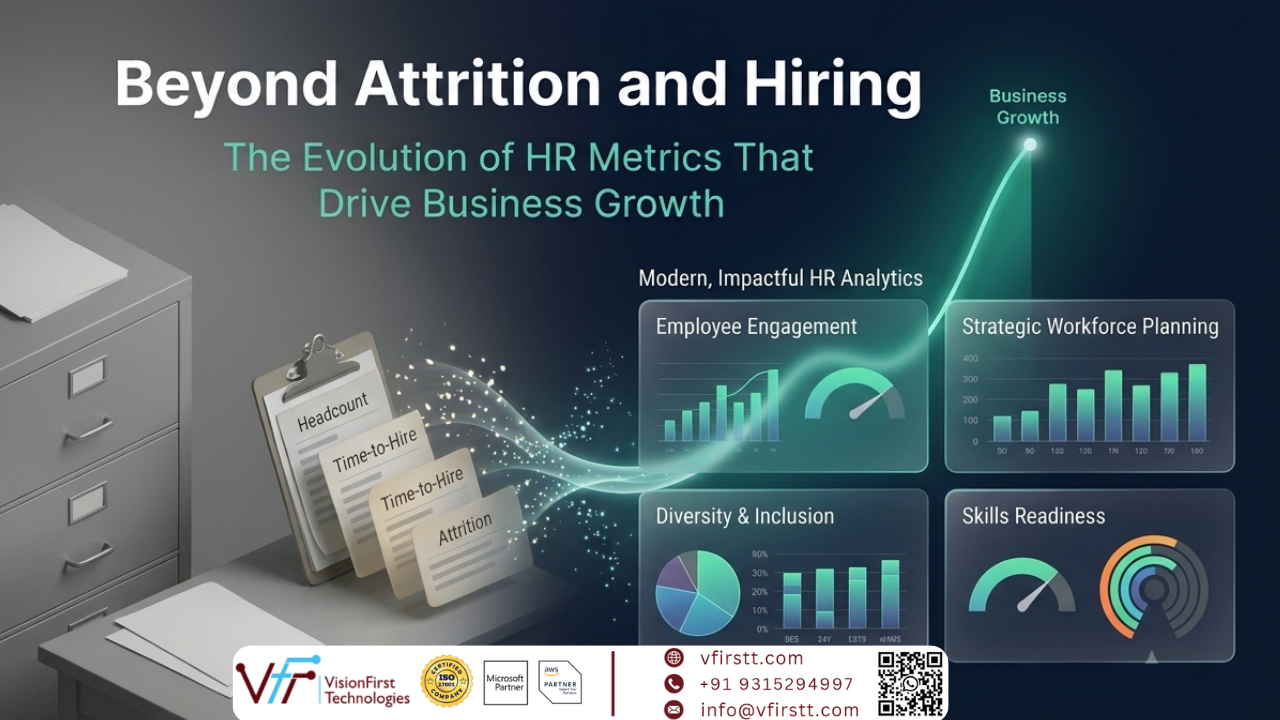
For decades, HR teams have relied on a familiar set of metrics to understand workforce performance.
Metrics such as:
- Employee Satisfaction Scores
These metrics serve an important purpose. They help HR teams monitor workforce activities. But there is an important question every HR professional should ask:
Do these metrics tell us whether the business is becoming stronger?
An organization can have low attrition, high training participation, and excellent attendance records, yet still struggle with productivity, innovation, skill shortages, or future growth.
This is where the traditional approach to HR measurement begins to fall short.
The Problem with Traditional HR Metrics
Most traditional HR metrics are activity-based.
They tell us what happened.
- How many people were hired?
- How many employees are left?
- How many training programs were conducted?
- How many employees attended learning sessions?
While these insights are useful, they rarely answer the questions for future growth:
- Are we building the skills needed for future growth?
- How quickly can employees contribute to business outcomes?
- Are our learning investments generating measurable value?
- Can our workforce adapt to new technologies and change business priorities?
- Are we developing talent internally or relying too heavily on external hiring?
In other words, traditional metrics measure workforce activity.
Modern organizations need metrics that measure workforce impact.
The role of HR is evolving from managing people’s processes to enabling business capability. As a result, the metrics we track must evolve as well.
Moving from People Metrics to Business Metrics
We see the future of HR as Workforce Intelligence, not simply HR Analytics.
Workforce Intelligence combines HR data, operational metrics, business performance, and predictive insights to help leaders make smarter workforce decisions.
Instead of reporting on what happened, organizations can anticipate future capability needs, identify workforce risks, and make proactive decisions that support long-term business growth.
Let’s explore some of the metrics that are helping organizations make that shift.
| Metric |
What It Measures |
How to Measure |
Business Decision |
| Time to Productivity |
How quickly a new hire reaches expected productivity |
Days from joining to defined productivity level |
Improve onboarding and ramp-up |
| Human Capital ROI |
Value generated relative to workforce investment |
Workforce value generated ÷ workforce cost |
Optimize people investments |
| Capability Value Realization |
Whether new capabilities create measurable outcomes |
Business value attributable to capability ÷ capability investment |
Prioritize high-value capabilities |
| Learning Impact / ROI |
Whether learning improves business outcomes |
Measurable performance improvement ÷ learning investment |
Improve learning programs |
| Time to Competency |
How quickly employees become proficient in new capabilities |
Days to demonstrated competency |
Accelerate transformation |
| Knowledge Risk |
Exposure from concentrated critical knowledge |
Critical knowledge areas without adequate backup ÷ total critical knowledge areas |
Prioritize knowledge transfer |
| Revenue per Employee |
Workforce productivity and scalability |
Revenue ÷ average employees |
Assess workforce efficiency |
A Practical Shift for HR Teams
The objective is not to eliminate traditional HR metrics.
HR teams will continue to need metrics for hiring, attrition, attendance, compensation, compliance, and other operational processes.
The shift is about adding another layer of measurement.
Instead of stopping at:
“What happened to our workforce?”
HR can ask:
“What changed in our workforce?”
And then go one step further:
“What business value or risk resulted from that change?”
For example:
100 employees completed an AI training program is an activity measure.
70 employees achieved the required AI proficiency is a workforce outcome.
45 of those employees were deployed on AI projects and reduced delivery effort by 15% demonstrates business impact.
That is the difference between measuring activity, outcome, and value.
What This Means for the Future of HR
The future of HR measurement is not about creating more dashboards or tracking more KPIs. It is about selecting the right measures and connecting them to decisions.
A strong workforce measurement framework should help HR and business leaders to understand Productivity, Capability, Investment, Adaptability, Talent, Risk, Future, Value. When these questions are connected to business data, HR moves beyond reporting and becomes a source of actionable business intelligence.
Our Perspective
At VisionFirst Technologies, we believe the future of HR lies at the intersection of people, data, and AI.
Our approach focuses on connecting workforce data with business outcomes rather than treating HR data as an isolated reporting function.
By combining analytics, business intelligence, automation, and AI, organizations can move from static HR reporting toward:
Measure → Understand → Predict → Act
The objective is not simply to build a more sophisticated HR dashboard.
It is to help organizations make better decisions about their workforce — where to invest, where to reskill, where to redeploy, where to hire, and where business risk may be emerging.
Because the most valuable HR metric is not necessarily the one that measures the most – It is the one that helps the organization make better business decisions.