



“From CTC restructuring to flexible workweeks, India’s New Labour Codes will reshape how IT companies hire, pay, and manage people in 2025.”
The world of work is evolving and so must be the way we manage people. As HR professionals in the IT and ITES sector, we’re operating in one of the most dynamic, fast-paced employment environments in the country. Every year, work models, employee expectations, and regulatory requirements shift and 2025 brings one of the biggest shifts of all.
India’s labour framework, which historically consisted of 29 separate laws, is now being reorganized into four consolidated Labour Codes. While these codes are designed to simplify compliance across sectors, their impact on the IT industry is far deeper than many realize.
As someone who manages people’s operations daily, I can say this:
These labour reforms will change the way we structure salaries, define work hours, manage flexibility, and build a compliant, employee-friendly workplace.
In this blog, let’s look at what the New Labor Codes introduce and how they will practically influence the IT sector beyond theory, from an HR lens.
The Four Labour Codes in Simple, HR-Friendly Terms
The 29 earlier labour laws are now restructured as:
1. The Code on Wages, 2019
Standardizes wage definitions and ensures transparent, fair wage practices.
2. The Industrial Relations Code, 2020
Strengthens employer–employee relations, formalizes dispute handling, and modernizes industrial governance.
3. The Occupational Safety, Health & Working Conditions (OSH) Code, 2020
Covers working hours, leave rules, safety standards, and welfare measures.
4. The Social Security Code, 2020
Extends PF, ESI, and Gratuity coverage; includes gig workers and freelancers.
Why IT Companies Should Pay Attention
There’s a common misconception that labour laws mainly impact factories, construction units, or manufacturing industries. But the reality is:
- The New Labour Codes apply to IT and ITES companies.
- Commercial establishments are explicitly included.
- The new definitions of wage, working hours, leave, and social security apply irrespective of whether the work is manual or digital.
- Remote workers, hybrid employees, and gig-based IT talent to fall under the new definitions.
In short: “If your organization employs people, the codes apply to you.”
Key Changes That Affect the IT Industry Most
Here’s a breakdown of the changes not as legal explanation, but from an HR perspective.
A. Code on Wages
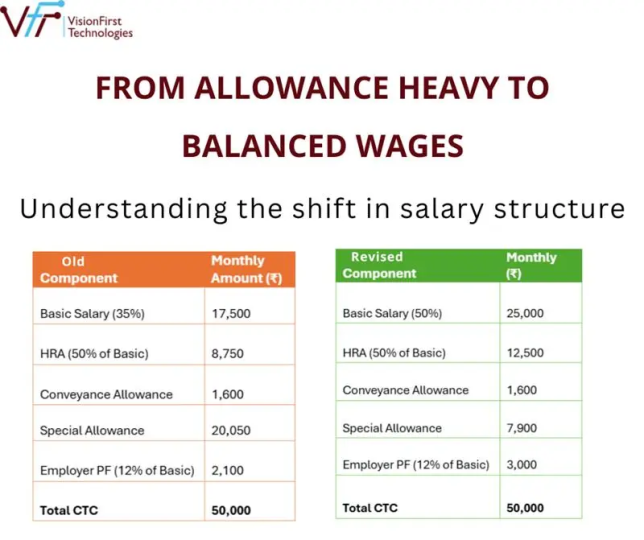
At least 50% of CTC must be “wages” –> and wages include Basic + DA + Retaining Allowance.
This means allowances cannot exceed 50%.
Before vs. Now: Impact on Salary Structure
| Aspect | Before (Old Structure) | Now (New Code) |
| Basic Salary | Often 30–40% | Must be 50% or more |
| Allowances | Often 50–70% | Capped at 50% |
| PF/Gratuity | Lower | Higher (due to higher Basic) |
| Take-home Salary | Higher | May reduce |
| Employer Cost | Moderate | Likely to increase |
This rule pushes organizations toward structured, benefit-focused compensation. For companies who are used to high special allowance slabs, this will require rebalancing salary formulas, offer letters, and payroll software.
B. Working Hours, Flexibility & Overtime (OSH Code)
This area directly affects IT service teams, 24/7 support units, and hybrid workforces.
Key Rules:
- Maximum 48 hours per week
- Option for 4-day, 5-day, or 6-day week
- Overtime must be paid at twice the wage
- Shift rules and night shift rules apply
- Weekly off is mandatory
Policies that allow scattered offs, fluid comp-offs, or unlimited flexibility will need refinement and documentation. IT organizations must re-align their leave structures with statutory limits.
C. Social Security Expansion (Social Security Code)
This code merges 9 major laws and brings a unified approach to PF, ESI, Gratuity, maternity benefits, and more.
- PF contributions will increase due to the 50% rule
- ESI may apply broadly based on government notifications
- Gig workers, IT freelancers, and platform workers may get defined benefits
- Gratuity liabilities increase
This is a shift toward long-term employee welfare. Startups, tech firms, and hybrid teams may need to redesign how they engage with gig workers and contractors.
D. Industrial Relations & HR Governance (Industrial Relations Code)
Important areas:
- The IR Code simplifies labor relations but requires more structured HR processes:
- Clear rules for discipline, misconduct, and grievance handling, retrenchment/layoff (for companies with 300+ employees)
- Stronger emphasis on employee communication and Faster dispute resolution mechanisms
- Standing Orders defining workplace rules (for eligible establishments)
Even if your IT company is below 300 employees, this code encourages:
- stricter HR documentation
- defined behavioral policies
- clear communication practices
This is a great opportunity for HR teams to standardize and modernize internal culture governance.
What This Means for Employees – A Balanced View
For employees, these changes bring:
- More predictable long-term benefits
- Clear working hour protections
- Stronger leave and safety norms
- Fairer wage structures
- Recognition for gig and flexible workers
Some may see reduced take-home salary, but long-term security increases significantly.
Conclusion
The New Labour Codes bring India closer to global employment standards.
For IT companies where flexibility, speed, and scalability are essential, adapting early will be critical.
As HR leaders, our job is not just to comply with the law but to prepare our organizations for a smoother transition. The sooner we understand the implications, the better we can redesign policies, educate employees, and ensure business continuity.




Push Notifications Success Stories: Short Messages, Big Impact

Staying Ahead: AWS Backup for Compliance and Security